Fire Safety and PV Modules on Roofs: An Integrated Approach

Fire Safety and PV Modules on Roofs: An Integrated Approach

20 April 2023


Yesterday, the Modern Building Alliance presented during the Fire Information Exchange Platform meeting the findings of the tests conducted by PU Europe on fire performance of PV on roofs highlighting the need for comprehensive assessments.

Photovoltaic (PV) panels on roofs are gaining traction as Europe moves very fast towards sustainable energy sources. However, ensuring fire safety in these installations remains a crucial concern. The needed integration of PV modules on roofs must consider fire safety through comprehensive risk assessments and appropriate rules.

Supporting the Transition to Clean Energy While Addressing Fire Safety Concerns

Large flat roofs offer an efficient space for PV arrays in developed areas. With the EU's RePowerEU initiative and directives like EPBD and EED promoting energy savings, the adoption of solar panels on roofs is on the rise. The lack of harmonised assessment methods for the fire performance of PV panels on roofs in Europe has raised concerns from some regulators and insurers about the fire safety performance of certain roof systems. The MBA would like to recall that a holistic approach is required, considering factors such as fire spread prevention, insulation system performance, and the prevention of PV panels becoming an ignition source.

Mitigate Fire Risks With An Integrated Approach

Enforcing existing technical provisions and rules is crucial to mitigate fire risks. Developing a fire performance assessment of PV panels, and developing a classification and method of assessment of fire safety based on the interaction between PV panels and the roof, allow for informed decisions regarding PV panel types suitable for different roof constructions and insulation systems. In many cases the existing roof systems can accommodate PV panels installations. In addition, ensuring firefighter safety and minimising risks during firefighting operations is paramount with an integrated approach considering installation design, such as mounting systems, separation distances, and proximity to fire safety facilities.


To know more:

PU Europe factsheet:

Fire performance of thermal insulation products in end-use conditions

About the FIEP.

EPBD Revision: Modern Building Alliance’s joint statement on the European Parliament’s fire safety considerations

EPBD Revision: Modern Building Alliance’s joint statement on the European Parliament’s fire safety considerations

23 March 2023


The Modern Building Alliance, under the umbrella of EuroFSA and eleven other organisations, signed a joint statement urging the European institutions to integrate fire safety into the final text of the revised Energy Performance of Buildings Directive (EPBD).

The EPBD revision aims to increase the energy performance of buildings in order to reach the EU climate objectives. It will also support the increase of the use of renewable energy, new sustainable solutions and technologies. Such evolutions should not impede fire safety. It is key to include fire safety considerations for new and renovated buildings. It is also key when installing and maintaining renewable and recharging infrastructures. Furthermore, the text could also include fire safety awareness campaigns for EU citizens, as fire safety education programmes are successful tools for fire prevention.

How do skills secure fire safety in buildings?  https://modernbuildingalliance.julien-gustin.be/fire-safety-skills-competency

The EU Fire Safety Guide https://modernbuildingalliance.julien-gustin.be/EU-fire-safety-guide


Review of the EPBD: TRAN’s opinion rejected

Review of the EPBD: TRAN's opinion rejected

27 October 2022


The Modern Building Alliance members deeply regret the rejection of the TRAN Committee's opinion on the Energy Performance of Buildings Directive (EPBD) revision. The Committee's adopted amendment calling for the European Commission to publish fire safety guidelines for car parks by 2025 was crucial for safely deploying electric vehicle charging points. Although the overall opinion was rejected, the specific amendment received strong support in TRAN.

Fire safety guidelines are key to safely roll out e-mobility

Installing charging infrastructure in buildings is vital for the widespread adoption of e-mobility, as most charging takes place at home or in the office. The Modern Building Alliance believes that ensuring fire safety measures accompany the deployment of in-building charging solutions is essential. Harmonised guidelines are needed at the EU level to address elements such as electrical safety, fire detection and suppression, ventilation, compartmentation, structural protection, and fire service intervention. These guidelines should be technology-neutral and based on performance standards and fire safety engineering.

European Parliament should reintroduce the amendment on fire safety guidelines for car parks

We urge the European Parliament to reintroduce the TRAN amendment, which proposes publishing fire safety guidelines for underground and surface car parks, facilitating the safe and coordinated deployment of electric vehicle charging points and ensuring the safety of European citizens. The EU Fire Information Exchange Platform (FIEP), coordinated by DG GROW, can be suitable for exchanging valuable information and developing these guidelines.

EU Fire Safety Week 2022

European Fire Safety Week 2022

EU Fire Safety Week 2022

Join us at European Fire Safety Week #EUFSW22 – putting fire safety at the heart of the renovation wave!

Ensuring safety is vital during construction, renovation, and retrofit. The European Green Deal, the Renovation Wave, the New European Bauhaus, the Social Climate Fund, and the REPower EU initiative provide opportunities to empower citizens, building owners, architects, builders, installers, and facility managers – to reduce the energy demand of buildings while improving their quality, their comfort and most importantly, the fire safety of the built environment.   

These initiatives are implemented through several legislative files currently discussed in the European Parliament: the revised Energy Performance of Buildings Directive, Energy Efficiency Directive, and the Construction Products Regulation. Standards underpin these policies to ensure the safety and performance of construction products and construction works.

Join us at #EUFSW22 to learn more about the importance of implementing the '7 layers for fire safety', a holistic and comprehensive approach that provides a guiding framework to ensure the fire safety of buildings (prevention, detection, early suppression, evacuation, compartmentation, structural safety, and firefighting...). Holistic approaches, such as performance-based design, focus on the processes needed to detect possible risks at an early stage and seek to maintain safety throughout the entire lifecycle of the building, protecting every citizen.

The European Fire Safety Week aims to highlight the importance of these recommendations and encourages industry stakeholders and policy makers to include fire safety measures during renovation, retrofit, and construction.

Curious? Register for the events co-organised by the European Safety Alliance and Modern Building Alliance on 15-16 November here. Seats are limited!

NEWSLETTER SIGN UP


The Modern Building Alliance is an alliance of trade associations and companies hosted by PlasticsEurope with registered office at Rue Belliard 40 - Box 16 1040 Brussels, Belgium. At PlasticsEurope we take privacy seriously.We collect your email address to send you our newsletter, and we do so on the basis of your consent. To know more on the way we process your personal data, take a look at our Privacy Notice

You can withdraw your consent at any time by clicking on the unsubscribe link at the bottom of our newsletter emails. If you have any questions about how we process your personal data, please contact us at privacy@plasticseurope.org


Fire Safety and the New EPBD

Fire Safety and the New EPBD

15 December 2021

The revision process of the Energy Performance of Buildings Directive (EPBD) started yesterday with the publication of a proposed text by the European Commission.

The new EPBD must fit with the European Green Deal Strategy and the Fit for 55 package aiming to decarbonise the buildings sector by 2050.

As mentioned by Commissioner for Energy, Kadri Simson, ‘Buildings are the single largest energy consumer in Europe, using 40% of our energy, and creating 36% of our greenhouse gas emissions. That is because most buildings in the EU are not energy efficient and are still mostly powered by fossil fuels. We need to do something about this urgently, as over 85% of today's buildings will still be standing in 2050, when Europe must be climate neutral. Improving our homes is also an effective response to high energy prices – the worst-performing buildings in the EU consume many times more energy as new or properly renovated ones. And it's often the most vulnerable who live in the least efficient houses and therefore struggle to pay the bills. Renovation reduces both the energy footprint of buildings and the energy costs for households, while also boosting economic activity and job creation.’

The Commission’s proposal sets buildings on a path towards decarbonisation. This should be done via highly energy-efficient building envelopes and decentralised renewable energy production alongside making them fit the energy transition, which means supporting much greater electrification of the mobility services (charging points for cars, bikes, etc.). Such evolutions can entail fire risks – and consequently, require expertise and know-how to manage them.

The Modern Building Alliance welcomes the wording in the proposal that considers that fire safety should be looked at holistically, together with other elements, when improving buildings.  We believe such considerations should focus on:

  • Fire safety as a prerequisite to any sustainability considerations because involving skilled and competent professionals will ensure the quality and compliance of building design, construction and renovation;
  • Making regular inspections of electrical systems a much more common practice because electrical inspection regimes will ensure the evolution of the energy system to be fully ready to transit.


The Own Initiative on the Implementation of the EPBD supports our call for regular inspections of electrical systems and goes a step further to ensure smoke management in case of fire (full details in this article).

On top of this, the European Commission put the topic of batteries on the agenda of the Fire Information Exchange Platform meeting in April 2021. The aim was to exchange with member states representatives and stakeholders how to deal with fire safety with new electrical cars.

The topic of fire safety in the context of the renovation wave was also on the agenda of the European Fire Safety Week. Access line up, recording and presentations


Additional information:

European Commission’s website

European Parliament’s EPBD report touches on fire safety

European Parliament’s EPBD report touches on fire safety

10 November 2021

Yesterday, the European Parliament’ Committee on Industry, Research and Energy (ITRE) adopted the Implementation Report of the Energy Performance of Buildings Directive (EPBD) by 49 votes in favour, 11 against and two abstentions. The report looks at how the current EPBD has been implemented in EU Member States and what could be improved. It repeats the central role buildings will play to reduce CO² emissions, tackle energy poverty and support the recovery of local economies. The report still has to be voted in Strasbourg during the Plenary of December or January.

The text covers a large range of considerations and includes some topics of particular interest for fire safety:

 Amendment 8d on page 7:  […]‘calls on Member States to develop an electrical inspection regime, since 30% of domestic and 75% of domestic accidental fires have an electrical source15;  (EPP 178)’…

Electrical safety as effective preventative measure

This recommendation refers to the White paper published by the Forum for European Electrical Domestic Safety (FEEDS, 2021) which states that in Japan, the number of fires has been reduced by close to 90% since inspections became mandatory in 1960’s.

The Modern Building Alliance welcomes this recommendation and fully supports the development of electrical inspection regimes. It proves that preventative measures effectively impact the number of fire casualties. Prevention is the very first layer of the 7 layers for fire in buildings which highlights the importance to address fire safety in a holistic manner starting with prevention, detection, early suppression, evacuation, compartmentation, structural safety and firefighting.

Smoke management is a key element of an efficient fire safety strategy

The report also addresses the question of smoke management in case of a fire.

Amendment 8d on page 7:  ‘[…] believes that the European building stock renovation should integrate electrical safety checks and upgrades and ensure sufficient ventilation for smoke in case of fire (EPP 178)’

All smoke is toxic and preventing occupants from being in contact with smoke will ensure an effective, safe and quick evacuation. Fire and HVAC engineers are highly qualified to secure buildings to be properly designed and equipped to be safe in case of a fire. The Modern Building Alliance advocates for the involvement of skilled and competent professionals to be involved in building design, renovation and also maintenance of buildings. It is the best way to ensure the building to be compliant, while meeting thermal performance, comfort and safety requirements.

Smoke management is another topic covered in the EU Fire Safety Guide in the layer related to compartmentation. In addition,  a full factsheet on Smoke management is accessible here.


The Modern Building Alliance has been calling since its founding for a holistic approach to fire safety of building and we are delighted to see some of our key recommendations being taken over by the ITRE Committee.

Access the voted text

High-rise building on fire in Milan

High-rise building on fire in Milan

1 September 2021


Following the fire of the high-rise building located in via Antonini in Milan that occurred on the 29th August 2021, the Modern Building Alliance wishes to express its sympathies to everyone affected by this unfortunate incident.

We would also like to give credit to the Milanese fire services for their rapid, professional, and effective intervention that ensured a safe evacuation of all occupants.


The ongoing investigation on the incident will clarify the circumstances and elements which contributed to the fire. Nevertheless, we noticed on social media and in some press, mentions related to the alleged involvement of polystyrene insulation.

We understand that the façade was clad predominantly in a mineral fibre (Euroclass A2) insulated ETICS system, with two large uninsulated Aluminium Composite Material decorative “sails”, offset from the ETICS system.


The Modern Building Alliance awaits the outcome of the investigation that will clarify the circumstances of this incident and will closely follow and support the conclusions and learnings helping to improve fire safety of façades of high-rise buildings.


‘Fit for 55’ Package issued

‘Fit for 55’ Package issued

14 July 2021

Today the European Commission has released part one of the ‘Fit for 55’ package.

This package contains a set of interconnected proposals to align EU policies on climate, energy, land use, transport, buildings and taxation to achieve the EU objective of reducing net greenhouse gas emissions by, at least, 55% of the 1990 levels by 2030.

The European Commission also published its Communication 'Fit for 55' that provides further details on its objectives, implementation and supporting measures. It states that, where possible, existing legislation will become more ambitious and new proposals will be developed where needed.

The building and construction sector is concerned by the update of the Renewable Energy and Energy Efficiency Directives. The update will be complemented by policy measures that will specifically support the building sector to improve the energy efficiency of buildings and reduce the overall energy needs of energy appliances/systems.

To tackle energy poverty, the New Social Climate Fund (€72.2 billion for 2025-2032) will support investments to increase the energy efficiency and renovations of buildings, clean heating and cooling, and integrate renewable energy in a manner that can sustainably reduce both CO2 emissions and energy bills for vulnerable households.

The Communication also refers to the revision of the Energy Performance of Buildings Directive (EPBD) to take place later this year. The text states: ‘The revision of the Energy Performance of Buildings Directive . . . will identify specific measures to accelerate the rate of buildings renovations, contributing to energy efficiency and renewable goals and greenhouse gas emissions reductions in the buildings sector.’


Additional information from the European Commission website:

Communication 'Fit for 55'

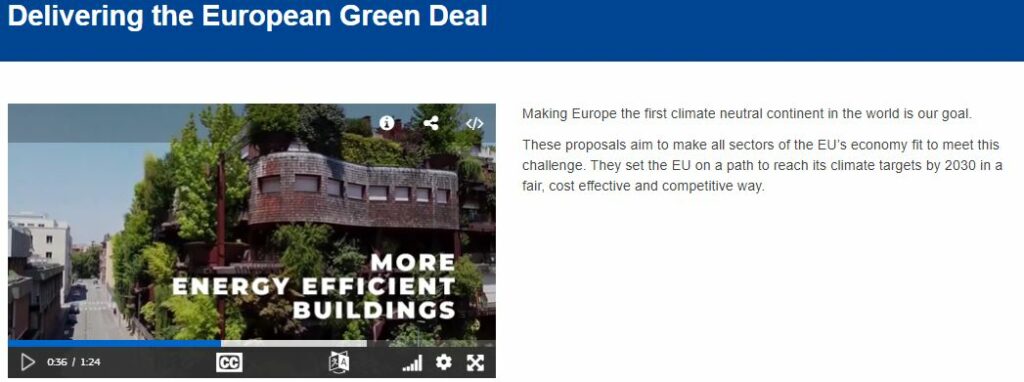
Factsheets on delivering the European Green Deal


Source: Screenshot https://ec.europa.eu/info/strategy/priorities-2019-2024/european-green-deal/delivering-european-green-deal_en

New Team for the Modern Building Alliance

New Team for the Modern Building Alliance

1 June 2021


The Board of Directors of the Modern Building Alliance is pleased to announce the appointment of Perrine Ethuin as the new Executive Chair of the alliance as from the 1st June 2021. She succeeds Quentin de Hults who will join another European organisation.


 ‘Perrine is the ideal successor to Quentin in his role within the Modern Building Alliance. Being involved in MBA activities for more than two years now, Perrine will further develop the MBA engagement with fire safety in our industry with policy makers and with other stakeholders to support the EU in advancing safe and sustainable construction. We wish her great success in her new role’.

Chair of the Board, Alberto Mercati, Dow


Perrine added: 'I am honoured and thrilled to be chosen to lead the Alliance. I will build on Quentin’s legacy to proactively open discussions and advance fire safety. With my new colleague Franklyn, we will carry on working in the same spirit and I look forward to collaborating with the plastics industry, stakeholders and EU policy makers to strengthen our contribution to the fire safety debate.'


As mentioned, Perrine is going to be supported by Franklyn Okwara. Franklyn is a Fire Safety Expert who graduated from the KU Leuven and from the Master of Science in Fire Safety Engineering in Ghent University. He will support the MBA Technical Working Group in its activities. 'We are very happy to have Franklyn on board to support the Modern Building Alliance’s ambition for a greater fire safety across the construction industry',  said Perrine.


The Board and all members of the Modern Building Alliance as well as the team would like to thank Quentin for initiating the Modern Building Alliance as well as his immense contribution and commitment to the Alliance since 2018.


The Board wishes Perrine all the best with her new position and welcomes Franklyn to the Modern Building Alliance.

Fire Australia Conference 2021

Fire Australia Conference 2021

11 May 2021


Today, the Modern Building Alliance was on the agenda of the Australian Fire Conference 2021 and tradeshow in Sydney.

Speaking via video from Brussels, as a guest of the sister organisation Australian Modern Building Alliance (AMBA), Quentin de Hults highlighted fire safety data from Europe, the 7 layers of fire safety in buildings and a proposed European regulatory framework – covering building, installation and organisational (B.I.O. framework) requirements for fire safety in taller (high-rise) buildings.

The information presented by the MBA highlights that a holistic approach is needed for fire safety in buildings and that prevention is multifaceted and goes beyond individual materials to include a more integrated system’, said the AMBA Chair, Dr Craig Lovel.

AMBA media release available here

About AMBA

The Australian Modern Building Alliance (AMBA) is an interest group of companies that was established in 2019 to represent the use of polymers in the Australian construction industry. AMBA’s goal is to ensure the benefits of polymer-based construction products are harnessed to create enduring modern buildings that are safe, sustainable and energy efficient.